

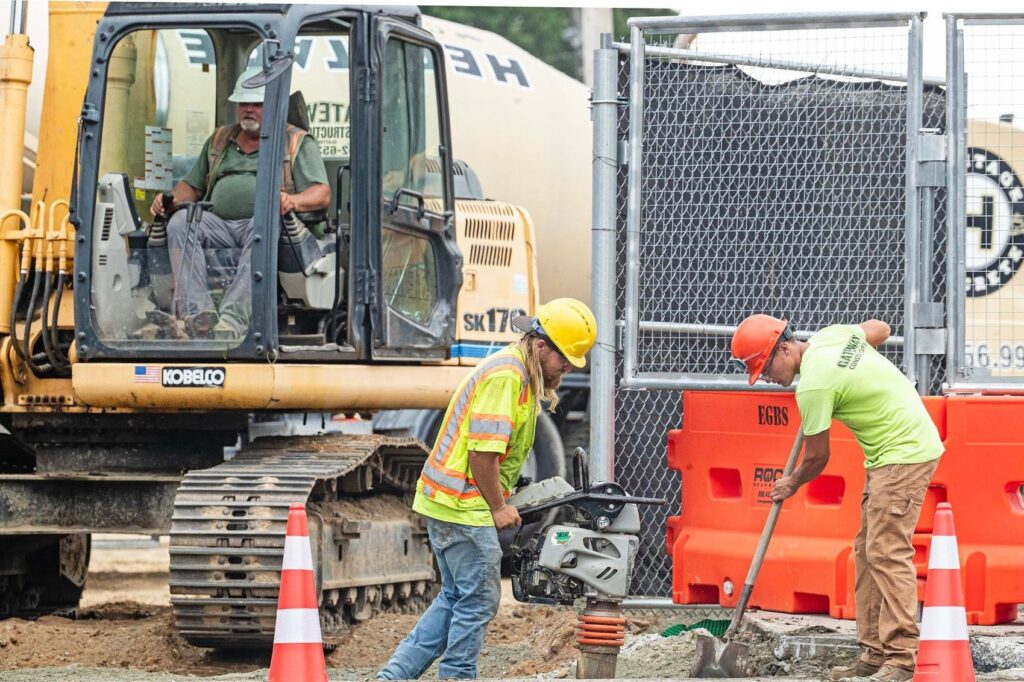
Construction Jobs’ Big Pay Raises Make Trades the ‘It’ Career in 2026
When it comes to salary boosts, the “it” career of the year is construction, a new survey shows.
Construction job-changers have out-earned every sector every month since August 2023, except in February and March 2026, when pay for job-changers in natural resources spiked temporarily, according to an analysis by human resources and payroll provider ADP of payroll transaction data. The review looked at more than 14.8 million individual workers over a 12-month period.
In June, year-over-year pay growth for job-changers in construction was up 12.9%, outpacing every other industry. Median gross pay was more than $59,100, compared to $43,200 for all job-switchers that month, ADP said.
At a time when people are struggling with and questioning the price of a college education, the analysis showed that specialized trades can also be lucrative.
“People who landed the biggest boost in pay so far this year were job changers in the construction industry, proving that investing in specialized trade skills can be another valuable gateway to making big bucks,” wrote Nela Richardson, chief economist and head of ADP research. “Specialty trades are the ‘it’ career of the year when it comes to pay.”
What’s Boosting Construction Pay?
It’s a simple story of supply and demand, ADP said.
Construction hiring has outpaced overall job growth since at least 2014. Between 2014 and 2024, construction saw the strongest employment gains of any sector outside of the big trade, transportation, and utilities category, which includes retail workers and truck drivers, Bureau of Labor Statistics data show.
Even with those job gains, construction has still needed more workers, Richardson said. As a result, “with a limited labor pool, (construction) workers have the power to command big jumps in pay when they switch jobs,” she said.
Why Is There a Shortage of Construction Workers?
A dearth of new entrants amid a data center boom have contributed to the construction worker shortfall, ADP said.
Older workers have carried the construction industry for years, ADP data show. Since January 2020, the median age of electricians, plumbers, carpenters and HVAC professionals has fallen by as much as five years as the age of U.S. workers has fallen only by one year. The drop in median age is because older workers are leaving the profession, putting more strain on the industry, ADP said.
Additionally, though data centers may account for less than 2% of the construction industry, these projects have a big “halo effect,” boosting knock-on demand for residential and infrastructure labor, according to the American Institute of Architects. In May, nonpartisan thinktank Brookings estimated that data centers contributed to an 11% increase in local construction jobs over five to six years.
What’s Next for Construction Workers?
The hiring boom for construction workers, along with their rising salaries, is likely to continue, and more apprenticeship and trade programs will emerge for people who want to enter the industry, ADP said.
“Construction workers are in high demand, with even private-sector companies outside of the industry creating apprenticeships and training programs to fill the talent gap,” Richardson said. “There’s early evidence that these efforts are luring new workers. The percentage of new hires in the construction industry – that is, people hired in the past three months – has been on the rise.”
From 2019 to 2025, new hires accounted for 3.6% of employment, ADP data show. So far this year, the share of new hires in the industry has grown by a full percentage point, to 4.6%.
Medora Lee is a money, markets and personal finance reporter at USA TODAY. You can reach her at [email protected] and subscribe to our free Daily Money newsletter for personal finance tips and business news every Monday through Friday morning.